

Above: Driftwood Sculpture, Gabriola Commons, Anonymous, ca. 1998
Revenge of the Real
Rural Installations
Installation, in a rural context, means constantly engaging with 'nature' and its materiality in its symbolic and social dimensions as it presents physical works that engage with problematic as well as celebratory aspects of rural aesthetics. Chief among these questions are the nature of domesticity and labour relations, and instances that disrupt established colonial as well as post-colonial role models, to modes of 'rural' behaviour that inscribe themselves through diverse performative practices.
Depending on the nature of the work, some is shown online and some in physical settings, either in stand-alone exhibition format or as documentation of an ongoing process. Some recent and current examples include:
[ Project 002.025.05.001 ]
En y regardant de plus près | On Closer inspection
Domestic Materiality
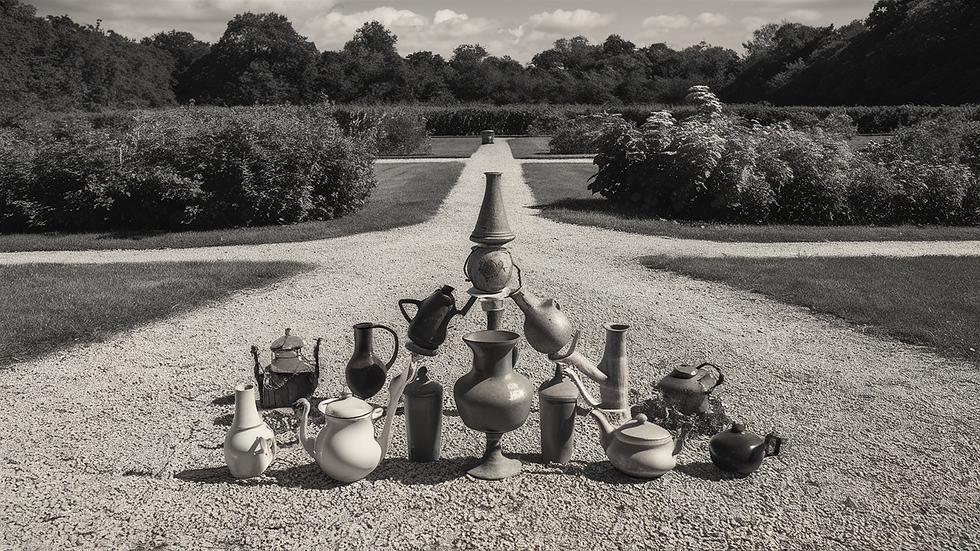
'En y regardant de plus près...' is a serial sculptural installations, investigating domestic materiality by foregrounding tensions between material and formal elements articulating the artist's attempt to align themselves with a Native American sensibility on the one hand, and a Lacanian approach to psychoanalytic interpretations of domesticity in objects that —in non-symbolic discourse, and when viewed in isolation— seem to express little but their utilitarian value and the process of mass production of which they are the product, but which, when assembled in totemic configurations assume a radically different set of expressive connotations.


On Closer Inspection, Sculptural installation ascribed to the cleaning staff of Silva Bay Motel, Photographs Anonymous, ca 2018
[ Project 002.025.05.004 ]
Duchamp and the Rural imaginary :
The [Re]Assembled Avant-garde
Instances of Reconstruction as Resistance

Untitled '[Re]assemblage' of Marcel Duchamp 'The Bride Stripped Bare by Her Bachelors, Even', Gabriola 'Southern End Welders Group', ca. 2023

This project stages an improbable encounter between two seemingly incompatible worlds: the rarefied canon of 20th-century avant-garde and the pragmatic, tool-scarred hands of Gabriola Island welders and handymen. In their inventive and irreverent assemblages, these local makers reimagine seminal works—Marcel Duchamp’s Nude Descending a Staircase or The Bride Stripped Bare by Her Bachelors, Even, using the humble detritus of rural life: worn fence posts, salvaged plywood, rusted hinges, bent screws, chainsaws that no longer cut, pulleys, washers, fishing line, belt sanders, and bolts.
These are not imitations, nor are they parodies. They are acts of radical appropriation—rural counter-readings of an art history long thought to belong elsewhere. In repurposing the gestures and geometries of Cubism, Futurism, and Dada through the materials of the workshop, shed, and scrapyard, these works force a revaluation of both art and labor. They pose a provocative question: What does it mean to reconstruct the avant-garde, not in the salon, the studio loft, or the museum, but in the backyard, the woodshed, or under a tarp next to a partially dismantled carburetor?
Interestingly, these are also collective artworks rather than the labour of a single artist, artisan or, to follow the implied hierarchy to its bottom rung, handyman. As such, they are anonymous works, the labour of a group of friends, a club, a secret cabal. The only known attribution, to the six extant ‘versions’, ( if such a term can be meaningfully applied ) of ‘The Bride Stripped bare by her Bachelors, Even’, made by a neighbour, claims authorship by the ‘Southern End Welder’s Group’; an entity documented nowhere else. Is it a ruse, a private jest, a silent protest?
Historically, the avant-garde positioned itself as a break with bourgeois decorum, a leap into the unknown. Yet its legacy became institutionalized, ossified into theory-laden exhibitions and elite markets. By contrast, the Gabriola handymen reclaim that spirit of rupture not by quoting the avant-garde but by physically rebuilding it—cutting, welding, fastening it into their world, on their terms. Their works are clunky, sturdy, improvised; they are beautiful not in spite of but because of their idiosyncratic fidelity to making-do.
This practice cannot be divorced from place. Rurality is not a backdrop—it is a logic. The materials themselves carry the embedded narratives of the island: broken tools used to mend fences, scrap wood from collapsed docks, coils of wire once used to hold together the practical fictions of day-to-day living. Assembled into abstract figures and philosophical machines, these objects enter into a new economy of meaning. They become speculative devices: what Deleuze might call machines désirantes, or what Manuel De Landa terms part of the machinic phylum—a non-organic life of matter and form in continuous recombination. Here, tools and fragments assert their own material histories; they evolve not only as art, but as nodes in a larger flow of forces—thermodynamic, territorial, affective.
But a work like Duchamp's 'The Bride stripped bare by her Bachelors, Even' is the result of a decades-long, painstaking development of both psychological and material hermeneutics, likely either out of reach or out of grasp for the ‘Southern End Welder’s Group’. What, then, are these devices a [re]construction of? A mere misunderstanding, a crude approximation based on a handful of formal cues? Their sheer physical authority seems to suggest otherwise — these are not replicas, nor mere quotes; they dissolve the solipsistic aspect of then ‘original’ work by distributing it, both formally and thus hermeneutically. ‘We’, they seems to say, ‘are all bachelors’ — a speculative statement not without resonance in the conditions of single males in a rural environment.
In this way, The [Re]assembled Avant-Garde is not a nostalgic exercise or a quirky footnote. It is a genuine act of cultural reinvention. It affirms that the avant-garde is not the property of cities or capital, but a mobile language—one that can be spoken even in the most unassuming of places and dissolve the bourgeois 'uniqueness' of the original into the ontological shimmer of a multiple, both undermining and exaggerating its authority.
What these Gabriola makers offer is not just homage but a kind of quiet insurrection: a declaration that art can be made from what’s at hand, that modernism is not over, and that every bolt screwed into a cracked two-by-four may carry with it a refusal—not of history, but of exclusion. In that refusal lives what Agamben calls the messianic remnant—a fragment of time suspended, neither redeemed nor lost, but insistently alive. These works speak from that suspended space, bearing witness to a form of life and art that remains ungoverned, unfinished, and, most importantly, even now, still to come.
Two examples of the 'Reassemblage' of Marcel Duchamps' 'The Bride Stripped Bare by Her Bachellors, Even', Gabriola 'Southern End Welders Group', ca. 2021
Sculptural 'Reassemblage' of Marcel Duchamps' 'Painting 'Nude Descending a Staircase'
Gabriola 'Southern End Welders Group', ca. 2019


Lecture Series
The Aesthetics of Disappointment
Imperfection in Rural Art as an Act of Liberation

Rural Ikebana Flower Arrangement, subjected to Entropy, ca. 2020, Artist anonymous.
Attempted and subsequently abandoned Installation using rural furniture and single engine airplane, 2019. Author anonymous. Photography by B. Pope (?)

Poorly executed assemblage at the Gabriola Commons lower garden site. Author anonymous, ca. 2011
This series of talks proposes disappointment not as failure, but as a radical aesthetic strategy—a refusal of perfection as imposed by dominant cultural, economic, and institutional systems. The Aesthetics of Disappointment gathers works by rural artists whose practices embrace imperfection, incompleteness, and the handmade as forms of resistance. In these gestures—frayed edges, unpolished surfaces, uneven forms—we encounter not inadequacy, but liberation.
In rural contexts, perfection is a distant ideal, often imported from elsewhere. The conditions of rural art-making—material scarcity, spatial isolation, and the lack of formal recognition—mean that technical polish and market-ready finish are frequently impossible. But what emerges in their place is a different kind of beauty: one rooted in process, immediacy, and authenticity. This is art shaped by weather, time, and improvisation. Here, imperfection becomes a language of honesty and intimacy, challenging the smooth surfaces of metropolitan art economies.
Disappointment is not just personal; it is structural. It names the moment when the promises of recognition, success, or progress fail to materialize. For rural artists—especially those working outside of dominant narratives, including Indigenous makers, self-taught elders, and those whose practices blur craft, ritual, and art—disappointment is a constant companion. Rather than turning away from it, the artists referred in this series turn toward it, transforming it into a creative resource.
Drawing inspiration from feminist, decolonial, and queer aesthetics, The Aesthetics of Disappointment positions imperfection as a political act. It recalls the Japanese concept of wabi-sabi, the Fluxus emphasis on the everyday, and contemporary performance art’s embrace of vulnerability. In this framework, to disappoint is not to fall short, but to decline participation in systems that demand conformity, virtuosity, and commodification — it is to reject polish in favor of presence. They do not apologize for their irregularities; they assert them. In doing so, they open up space for a slower, more grounded, and more truthful aesthetic experience.

Lecture Series offered by Sky Wallace, (them/they),
Media Art Curator

"[Re] Centering the Rural Object "