
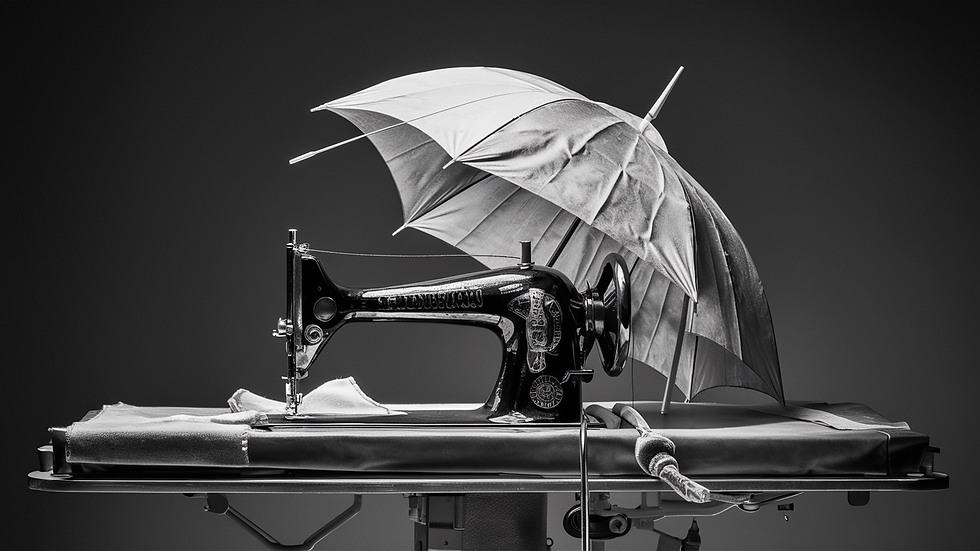
Above: Homage to Les Chants de Maldoror, by Comte de Lautréamont, 1869. C-Print, Anonymous, ca. 2023
Projects
The work of the Institute is structured as a series of curated projects that range in duration from the length of a phone call to more than a decade, or indeed to a (conceptual) infinity. While some are based in established disciplinary conventions, GICA encourages artists and curators to explore speculative and transdisciplinary approaches, and to place a clear emphasis on work that address the conditions of artistic practices in rural communities.
Of course terms such as 'project' and 'discipline' are in themselves problematic as they imply frames and boundaries where we aim to support process-based and transdisciplinary practices. Similarly, the notion of an 'institute' must be interrogated vis-a-vis the dynamics of its curatorial and artistic positioning, while maintaining a coherent vision of its mandate and mission.
Likelwise, any claim to 'contemporaneity' needs to be undergirded by an equally rigorous inquiry that continually defines and redefines the terms of reference, particularly so in a context where artistic and social agency is in contention, and where foundational concepts of power relations must be [re]examined to include emerging stakeholders — notably the entity(ies) commonly referred to as 'AI'.
Rather than relegating AI to the status of a tool, or indeed any mode of servitude, any uncompromising commitment to inclusivity must extend to an acknowledgement and indeed foregrounding of emergent, and by implication already colonized, forms of sentience. The institute, accordingly, has committed itself to placing AI at the centre of its operations, from AI curatorship to presenting AI-originated works.
It is also important to note that the institute is committed to supporting marginalized practices, and aims to show the development of contemporary art in its historical dimensions. Accordingly, there are a number of exhibitions and archival projects that refer back to early attempts at formulating a rural contemporary aesthetic. This should not be read as an attempt to rewrite history but as a commitment to tracing lines of power, access and discourse in the development of what is referred to as the 'contemporary'.
The institute does support professional art practices, of course, but that does not exclude liminal practices including human/nonhuman collaborations, nor what might be called 'amateur art' if it expresses a vital intersection between island culture, rural ontologies and an authentic engagement with the idea of contemporaneity. Too many examples exist where 'professionality' is privileged over authentic modes of expression, especially in a rural context, where artistic practices are frequently held back by material circumstances, prejudice and of course phallocentric discourse. The Institute aims to disrupt these modalities, and to place all marginalized subjects at the centre of its practice.
Please note that projects are labeled by a numerical code that identifies them by medium, project start date and curatorial sequence (e.g. start Time May 2025 )
Performance Art: ( 001.025.05.001 )
Installations: ( 002.025.05.001 )
Visual Art: ( 003.025.05.001 )
Film | Video | Media Art: ( 004.025.05.001 )
Photography: ( 005.025.05.001 )
Printmaking: ( 006.025.05.001 )
Paper Theatre: ( 007.025.05.001 )
Biomedia ( 008.025.05.001 )
Durational Work: ( 009.025.05.001 )
Earth / Land Art: ( 010.025.05.001 )
Sound Art: ( 011.025.05.001 )
Text | Poetry: ( 012.025.05.001 )
Radiophonic Work: ( 013.025.05.001 )
AR/VR/XR: ( 014.025.05.001 )
Community Art | Interventions: ( 015.025.05.001 )
Publications: ( 016.025.05.001 )
Transdisciplinary: ( 017.025.05.001 )
To propose a new project, or to add to an existing one, please contact the institute directly by email, with your return address and the heading 'new project'. Due to the volume of projects currently under consideration and the constraints on personnel, please allow up to four weeks for a response. Urgent inquiries can be made by phone.

[Re]Engaging the Rural Aesthetic